

General Questions
- What makes Ecolint different from other international schools in Geneva?
Ecolint combines academic excellence with a strong focus on international mindedness, multilingual learning, wellbeing, and inclusion. As the birthplace of the International Baccalaureate (IB), Ecolint has a long-standing reputation for innovation in education and global citizenship.
- Is Ecolint an IB school?
Yes. Ecolint played a key role in the development of the International Baccalaureate (IB) and offers IB programmes alongside other internationally recognised pathways depending on campus and age group.
- How international is the student community?
Ecolint welcomes students from over 130 nationalities and promotes a diverse, multilingual, and globally connected learning environment.
Admissions
- How do I apply to Ecolint?
Families can apply online through the admissions portal. The process typically includes submitting an application form, school reports, references, and other supporting documents.
- What documents are required for admission?
Required documents may include:
- Previous school reports
- Passport or ID copies (for some year groups)
- A recent passport size photo (head and shoulders, to be used for school ID card)
- Proof of date of birth (photocopy) for applicants up to and including age 5 (Pre-Reception, Reception and Year 1)
- Copies of the end of year school reports for the last 2 years (in English or French), assuming your child has been in school
- Copy of the current year school reports (if applicable)
- Essay: a brief handwritten description by the child of himself/herself and his/her interests - without assistance, or a recent drawing (self-portrait), if the child cannot write yet, with his/her name underneath
- Online payment of the application fee of CHF 250.- (see "Tuition & fees")
Requirements may vary by age group.
- Can students join during the school year?
Yes. Depending on availability, we accept applications throughout the year for many year levels.
- Is there a waiting list?
Some year groups and campuses may have limited availability. Admissions teams can advise families on current waiting list situations.
- Does my child need to speak English or French before joining?
No, your child does not need to already speak English or French before joining Ecolint. The school welcomes students from many language backgrounds. Language support is provided to help students develop their English and/or French after entry, so they can fully access the curriculum and integrate into school life.
- Can we visit the campus before applying?
Yes. Families are encouraged to attend open days, guided tours, or virtual information sessions to learn more about the school community and campuses.
Academics & Curriculum
- What curriculum does Ecolint offer?
We provide a variety of rigorous, child-centred programmes across our three campuses:
- Campus des Nations is a certified IB continuum school, offering all four International Baccalaureate programmes: the Primary Years Programme (PYP), Middle Years Programme (MYP), Diploma Programme (DP), and Career-related Programme (CP).
- La Grande Boissière: students follow the school's unique Universal Learning Programme (ULP), which focuses on deep understanding and competence development, alongside the IB Diploma Programme in the final years.
- La Châtaigneraie: students follow the PYP in Primary and the MYP in Years 7–9. From Year 10 onwards, they can choose between the IGCSE, the IB Diploma pathway or the Swiss Maturité (maturité fédérale).
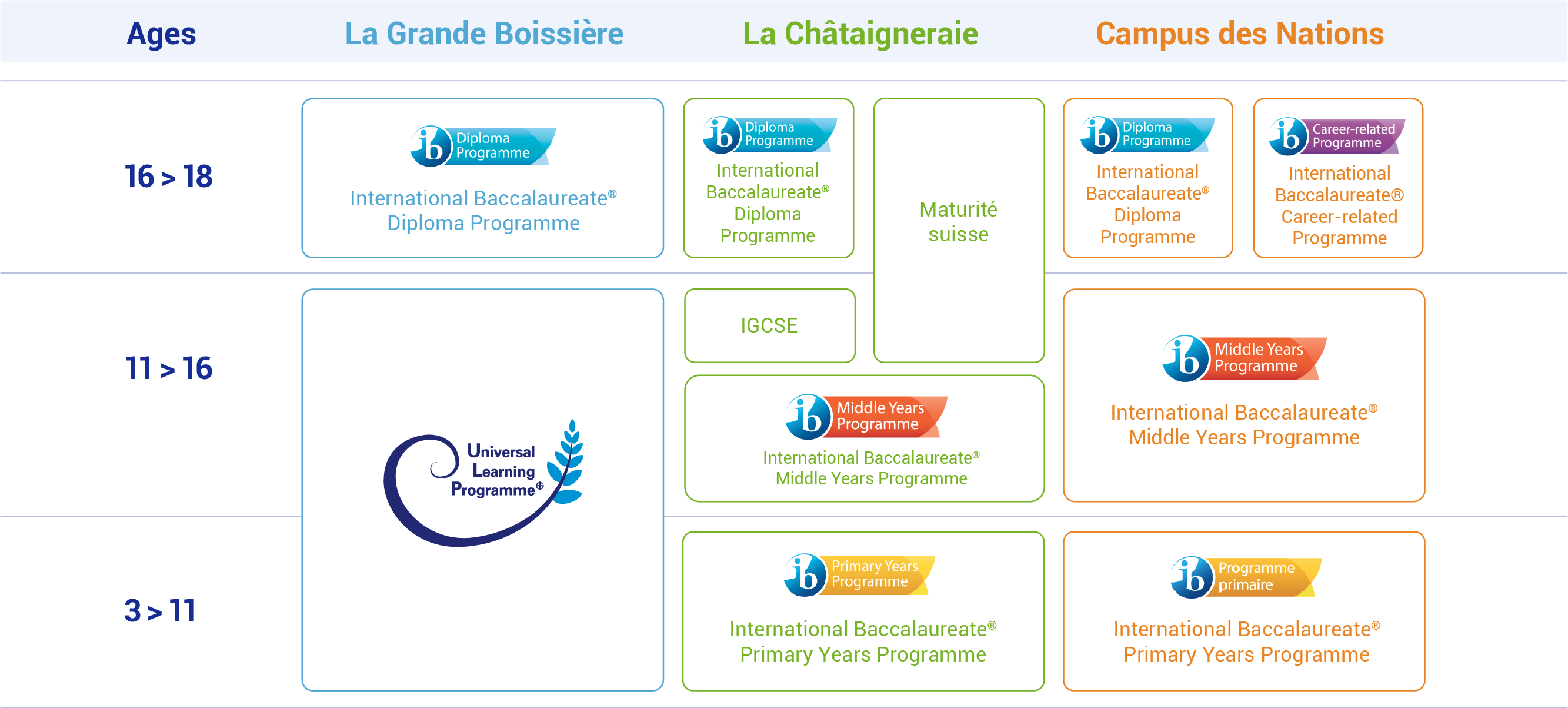
- Campus des Nations is a certified IB continuum school, offering all four International Baccalaureate programmes: the Primary Years Programme (PYP), Middle Years Programme (MYP), Diploma Programme (DP), and Career-related Programme (CP).
- What languages are taught at Ecolint?
We offer a sophisticated multilingual approach tailored to each campus and age group, ensuring students become proficient in both English and French while supporting their home languages.
La Grande Boissière: "A la carte" bilingualism
- Primary School: Students are orally exposed to both languages in Pre-Reception, with a focus on establishing strong literacy in their strongest language (English or French) from Reception to Year 2. From Year 3, exposure to the second language increases to seven periods per week.
- Middle School: Families choose between the English Language Programme, which builds strong academic English while advancing French, or the French Bilingual Programme, which develops high-level academic bilingualism.
- Secondary School: we offer a unique "à la carte" approach where students can choose their language of instruction (English or French) for almost any subject.
La Châtaigneraie: Structured Bilingualism
- Primary School: Children begin in a bilingual environment in Early Years with a designated "Language A". From Year 1 to 6, parents choose either the French or English pathway, with the curriculum being identical in both, complemented by four hours of weekly instruction in the second language.
- Secondary School: Students follow a curriculum in English, French, or a bilingual combination through Year 9. From Year 10, they choose between an anglophone pathway (IGCSE/IB Diploma) or a francophone pathway (Swiss Maturité).
Campus des Nations: A Responsive Language Model
- Primary School: We use an individualised approach. In Lower Primary (PR-Year 3), bilingual teachers adapt to the student's profile. In Years 4 and 5, students are organised into four groups based on their French proficiency, ranging from intensive English support to "Français+" (where French comprises approximately 40% of the programme). In Year 6, homeroom classes are offered in English-only, Mixed, or French-only formats.
- Secondary School: Instruction is primarily in English, complemented by robust French classes and the option for a bilingual IB Diploma.
World Languages Programme (WLP)
Across all three campuses, the WLP supports cultural diversity by allowing students to maintain their mother tongue or learn a new language. Over 25 languages—including Italian, Spanish, German, Chinese, Arabic and Swedish—are available either as part of the curriculum or as an extra-curricular activity.
- What are the class sizes?
Class sizes are generally small to moderate, but they vary by age group and campus.
- Early Years - Primary: about 18–24 students per class
- Lower Secondary: usually around 18–24 students
- Upper Secondary / Years 12-13: 22 students for Standard level subjects and 18 for Higher level.
- What are Ecolint Year levels equivalent to in the French education system?
Ecolint follows a British school year system (Years 1–13).
In general, Years 1–5 match French Primary School (CP-CM2), Years 6–9 match collège (6e-3e), and Years 10–13 match lycée (2nde-terminale). The final two years (12–13) are closest to the final stage of lycée but are taught through an international curriculum such as the IB Diploma or Career-related Programmes.
- How do Ecolint students perform in final exams?
Ecolint consistently achieves results well above the world average. In 2025, the pass rates were:
- Campus des Nations: 99% IBDP and 100% IBCP
- La Grande Boissière: 98% IBDP
- La Châtaigneraie: 94% IBDP and 93% Swiss Maturité
The average IBDP score across campuses was approximately 35 points, compared to a world average of 30.5 out of 45 points.
- How does Ecolint support university preparation?
Students benefit from university counselling, personalised guidance, academic advising, and preparation for applications to universities around the world.
- What is the deadline for enrolment?
We operate a non-selective and inclusive admissions philosophy at Ecolint. There is no fixed deadline for enrolment, and admissions are generally open throughout the year, subject to availability in each year group. However, we encourage families to apply early, especially for entry in August/September, as places can fill quickly.
Families are invited to contact the Admissions Office at admissions@ecolint.ch to discuss their child’s needs and receive guidance on the application process.
Student Life
- What Extra-Curricular Activities are available?
Our Extra-Curricular programme is built on five pillars available across all campuses:
- ENCORE Performing Arts Academy: Professional training in Dance, Drama, and LAMDA.
- Music School: Private lessons, theory, and orchestra opportunities for all levels.
- Sports: Competitive and recreational options, including the Ecolint Ski Team and the SPORTS+ Programme for elite athletes. We also host The Duke of Edinburgh's International Award for students in Years 9 to 13.
- Culture & Leisure: STEM projects, Visual Arts, Chess, Cooking, Odyssey of the Mind, and many more.
- World Languages Programme: supports cultural diversity by allowing students to maintain their mother tongue or learn a new language.
Programmes vary by campus and age group.
- How does Ecolint support student wellbeing?
Student wellbeing is embedded in daily school life through a comprehensive support system that includes pastoral care, advisory programmes, counselling services, and a strong commitment to inclusion and belonging. On campus, students also have access to school psychologists, nurses, and wellbeing counsellors who work together to support their academic, emotional, and social development.
- Does Ecolint provide school transport?
Transportation options are available depending on campus location and routes. Families can contact admissions for current transport information.
Learning Support & Inclusion
- Does Ecolint support students with additional learning needs?
Yes, Ecolint is a fully inclusive school that supports students with a wide range of additional learning needs, from mild learning difficulties to high potential. Support is provided through two distinct levels available across all three campuses:
- Learning Support (mild to moderate)
This level of support is available to all students who require academic assistance for mild to moderate difficulties. Because every learner is unique, the school designs individualised pathways tailored to a student's specific cognitive profile and the available resources. - Extended Support Programme (ESP - moderate to pronounced)
This specialised programme is for students who require more intensive, personalised, and specialist support than traditional teaching can provide.
Inclusion Model: Every ESP student is part of a mainstream class but follows a tailor-made individual education plan. This roadmap allows them to benefit from mainstream environments while also receiving specialist teaching in dedicated ESP facilities.
Holistic support: beyond academics, the programme offers social and emotional support through art therapy, adapted sports, and dance.
- Learning Support (mild to moderate)
- How does Ecolint promote inclusion?
Ecolint promotes inclusion by ensuring that every student feels respected, valued, and able to participate fully in school life. Inclusion is built into the school’s values and daily practice, not treated as a separate initiative. Through its Inclusion, Diversity, Equity and Anti-Racism (I-DEA) framework, we actively work to challenge discrimination and create a culture of belonging for all members of its diverse international community.
Inclusion is also supported through our highly multicultural environment, where students from many different nationalities learn together and develop understanding of different perspectives. Teachers and staff receive training to support inclusive practices in the classroom, and we encourage open dialogue and respect for individual identities and experiences.
Overall, we promote inclusion by combining clear values, supportive teaching practices, and a diverse community to ensure that everyone has equal opportunities to learn and succeed.
Tuition & Practical Information
- What are the tuition fees?
Tuition fees vary depending on grade level. Additional costs may include transportation, lunch services, learning materials, and extra-curricular activities. Details can be found here.
- Are uniforms required?
In general, the dress code is “smart casual” with an emphasis on being neat, practical, and appropriate for a school environment. We do not have a school uniform.
- What are the typical school hours for students?
Hours vary slightly by campus and age group:
Campus des Nations
- Primary starts at 8:15 (Wednesdays are half-days ending at 12:00)
- Secondary runs from 8:10 to 15:30 (until 16:15 for Years 12-13)
La Grande Boissière
- Primary hours are 8:30 to 15:00 (Wednesday: 12:00)
- Middle School runs 8:15 to 15:40 (Wednesday: 12:30)
- Secondary hours run from 8:15 with the finish time varying between 14:50 and 16:20 depending on the year level
La Châtaigneraie
- Primary runs 8:15 to 14:55 (Wed: 12:00)
- Secondary starts at 8:20, ending at 14:55 for Years 7-9 and up to 16:30 for older students
Campuses
- How many campuses does Ecolint have?
Ecolint operates three campuses: La Grande Boissière and Campus des Nations in Geneva, and La Châtaigneraie in the canton of Vaud.
- Which campus is right for my child?
The best campus depends on factors such as:
- Age group
- Preferred language pathway
- Curriculum interests
- Location
- Learning style
Our Admissions team can help you determine the best fit.
Still have questions?
Our Admissions team is here to help you learn more about Ecolint, explore campus options, and guide you through the application process.